Lobe das Verhalten, nicht die Person!
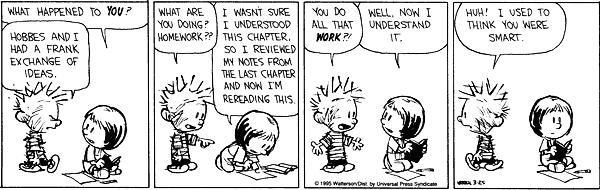
These findings are especially important in education and how we, as a culture, assess intelligence. In another study of hundreds of students, mostly adolescents, Dweck and her colleagues gave each ten fairly challenging problems from a nonverbal IQ test, then praised the student for his or her performance — most had done pretty well. But they offered two types of praise: Some students were told “Wow, you got [X many] right. That’s a really good score. You must be smart at this,” while others, “Wow, you got [X many] right. That’s a really good score. You must have worked really hard.” In other words, some were praised for ability and others for effort. The findings, at this point, are unsurprising yet jarring:
"The ability praise pushed students right into the fixed mindset, and they showed all the signs of it, too: When we gave them a choice, they rejected a challenging new task that they could learn from. They didn’t want to do anything that could expose their flaws and call into question their talent.[…]In contrast, when students were praised for effort, 90 percent of them wanted the challenging new task that they could learn from."
http://www.brainpickings.org/2014/01/29/carol-dweck-mindset/
“People with the growth mindset know that it takes time for potential to flower.” (p. 28) The inverse is that people with the fixed mindset don’t use the word “potential,” one either has IT or they don’t. As the author herself notes, “Until I discovered the mindsets and how they work, I, too, thought of myself as more talented than others, maybe even more worthy than others because of my endowments.” (p. 29-30) A fixed mindset considers that “effort is for those who don’t have the ability.” (p. 40) In one study with children some were praised for their ability while others were praised for their effort. “Since this was a kind of IQ test, you might say that praising ability lowered the students’ IQs. And that praising their effort raised them.” (p. 73)
Die konkrete Verbesserung
Nicht verallgemeinern.
Nicht die Person loben.

A final note of clarification from Dweck: “Perhaps it’s because, as Malcolm Gladwell suggests, people prize natural endowment over earned ability. . . . We like to think of our champions and idols as superheroes who were born different from us. We don’t like to think of them as relatively ordinary people who made themselves extraordinary.”


Kommentare